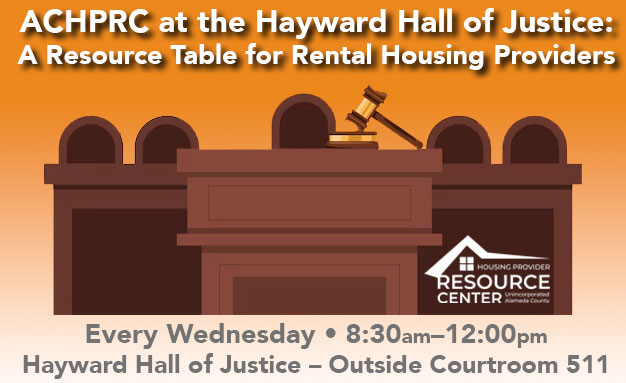

Every Wednesday morning, a small but vital support table is set up outside the Hayward Hall of Justice, offering resources to people navigating one of the most stressful moments in housing: eviction court.
The Alameda County Housing Provider Resource Center (ACHPRC) operates its weekly Courthouse Support Table to provide free, non-legal assistance to both renters and housing providers. Services include guidance on court procedures, referrals to mediation, and connections to housing resources designed to prevent disputes from escalating into costly and disruptive litigation.
Meeting People Where They Are
Eviction court often represents a crisis point. Many renters and housing providers arrive confused, overwhelmed, and uncertain about their rights, responsibilities, or next steps.
Recognizing this gap, ACHPRC established its Courthouse Support Table to provide immediate, on-the-ground assistance when it is most needed. Jalene Drew, ACHPRC’s Housing Provider Specialist, explains, “We saw a major gap between the legal requirements of eviction court and the practical understanding people bring with them. Our goal is to provide clear, timely guidance so people can move forward with confidence.”
Before proceedings begin in Courtroom 511, ACHPRC staff are stationed outside offering one-on-one assistance in a calm, nonjudgmental environment. Whether a housing provider is unsure how to properly serve notices or a renter is confused about court timelines, ACHPRC staff help clarify processes and connect individuals to appropriate resources.
Preventing Crisis Before It Escalates
ACHPRC’s mission extends beyond supporting people on their court date. Its broader goal is upstream intervention—preventing disputes from reaching the courtroom in the first place.
Rather than engaging only after cases have entered the legal system, ACHPRC focuses on education, early problem-solving, mediation referrals, and access to county resources. This approach helps people avoid the emotional, financial, and time-intensive costs of litigation.
Volunteer Jorge Jimenez, a housing provider, notes, “When small landlords make simple mistakes—like missing a deadline or filing paperwork incorrectly—it can cost them months of rent and create major financial stress. Helping them correct those issues early can make a big difference.”
Since launching the pilot program, ACHPRC has assisted dozens of individuals in resolving issues before they escalated into formal legal battles. From correcting filing errors to connecting renters with rental assistance, the courthouse presence has had a measurable impact on housing stability.
Neutral, Collaborative Support
What distinguishes ACHPRC is its neutral, fact-based approach. While eviction court can feel adversarial, ACHPRC serves both renters and housing providers with the goal of reducing tension and promoting lawful, fair outcomes.
“We’re not taking sides,” says Drew. “We’re here to provide accurate information so both parties can understand their options and responsibilities.”
By supporting both sides, ACHPRC helps prevent misunderstandings and encourages resolution outside of court. In many cases, conflicts that appeared headed for litigation were resolved through clarification or mediation.
Navigating Systemic Challenges
Despite strong community response, ACHPRC’s work has not been without challenges. There have been instances where court staff raised concerns about ACHPRC’s physical presence, including a disruption in which staff were instructed to remove signage and vacate the second floor after weeks of prior cooperation.
These moments highlight the institutional friction that can arise when prevention-focused models intersect with systems traditionally oriented toward litigation. Still, ACHPRC remains committed. “The need for timely, accurate information is undeniable,” says Drew. “Our focus is making sure people leave court better informed, regardless of obstacles.”
The tension reflects a broader debate between prevention and reactive legal intervention. ACHPRC’s model prioritizes resolution before escalation—sometimes challenging established systems that engage primarily once cases are already underway.
Looking Ahead
ACHPRC aims to maintain its courthouse presence to ensure accurate information reaches people navigating eviction court, empowering them to move forward with clarity and intention.
“The earlier we can reach people, the better the outcomes,” Drew says. “Education and connection before court benefits everyone.”
ACHPRC measures success not by cases handled, but by cases prevented. Each resolved conflict, corrected error, or successful referral represents a win for housing stability—reducing strain on the courts and preserving homes.
Through its Courthouse Support Table, ACHPRC is strengthening housing stability in Alameda County. By meeting people at critical moments and focusing on prevention, ACHPRC is creating fairer outcomes for renters and housing providers alike—while helping build a more equitable housing system.
For in-person assistance, visit the ACHPRC table at the Hayward Hall of Justice every Wednesday from 8:30 am to 12 noon.