How Measure W Will Shape Alameda County’s Approach to Tackling Homelessness — And Why Prevention Must Be a Priority
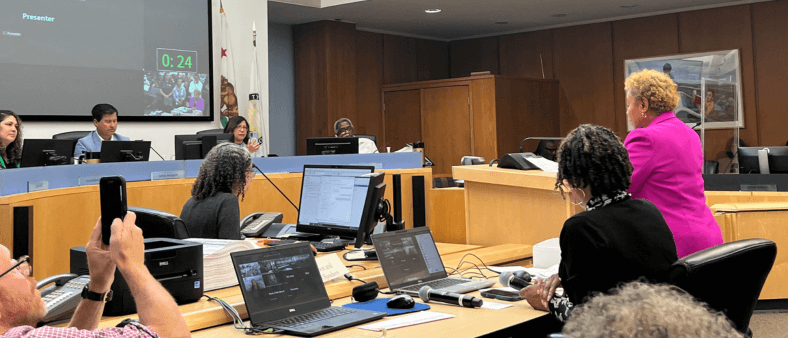
Alameda County is entering a pivotal moment in its homelessness response. With the long-delayed release of Measure W funds now moving forward, the County is preparing to deploy more than $1.4 billion over the next eight years through the Home Together Fund—a major source of local investment dedicated to reducing homelessness, expanding housing, and strengthening services countywide. As the landscape of state and federal funding becomes increasingly uncertain, Measure W represents a once-in-a-generation opportunity to stabilize the system, preserve existing programs, and invest in long-term solutions. But it also presents a critical question: How can we ensure these dollars reach the people most at risk—before they lose their housing? ACHPRC engages with this question every single week at our outreach table at the Hayward Hall of Justice, where we encounter residents—especially elderly renters and long-time community members—who are one crisis away from homelessness. Their stories underscore the urgency of strong prevention investments and guide our ongoing advocacy to ensure Measure W addresses not only those already unhoused but also those struggling to stay housed.
Understanding the Home Together Plan
The Home Together Plan is Alameda County’s roadmap for building a coordinated, equitable homelessness response system. The 2026 version of the plan was adopted by the Board of Supervisors, city partners, and the region’s Continuum of Care. The County is now refreshing the plan as Home Together 2030, incorporating:
- Updated modeling of countywide homelessness needs
- A strengthened racial equity analysis
- Insights from cities, service providers, and people with lived experience
- New data, including Point-in-Time Count findings
The strategic priorities remain clear:
- Prevent Homelessness
- Increase Housing
- Expand Shelter Capacity
- Improve Access & Coordination
These principles shape how the County intends to deploy Measure W funds.
What Measure W Funds Will Support
Measure W is a voter-approved half-cent sales tax dedicated to homelessness and essential county services. After clearing legal challenges in 2025, it now provides:
- $1.4 billion over 10 years for the Home Together Fund
- $258 million for Essential County Services
- A $170 million Prudent Reserve to provide stability during economic downturns
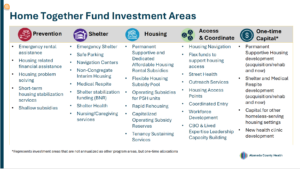 Over eight years, Measure W investments will be phased in, with early priorities including:
- Expanding interim housing
- Launching a flexible housing subsidy pool
- Developing a capital investment fund
- Increasing bed-night reimbursements for shelters
- Stabilizing affordable housing providers
Homelessness Trends Underscore the Need for Action
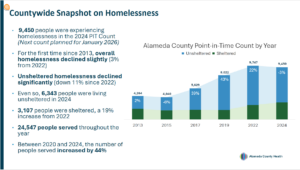 The presentation data makes clear that the County is at an inflection point:
- 9,450 people experienced homelessness in 2024
- Unsheltered homelessness dropped 11%, the first decline in over a decade
- Sheltered homelessness increased by 19%
- Over 24,500 people accessed services in a single year, a 44% increase since 2020
These improvements show that coordinated investments work. But upcoming cuts to federal and state homelessness funding—an estimated $33–$60 million loss beginning in 2026—mean Measure W will play a crucial stabilizing role.
Why Prevention Must Be Front and Center: What ACHPRC Sees Every Week
ACHPRC’s outreach table at the Hayward Hall of Justice has become one of the clearest windows into the housing instability facing Alameda County residents. Week after week, we meet:
- Elderly homeowners on fixed incomes threatened by rising costs
- Families on the verge of eviction after a medical bill or job loss
- People who have never asked for help before, suddenly facing homelessness after a single setback
These are not hypothetical scenarios—they are the daily realities of the people who come to us looking for guidance. Many simply need one-time emergency help—a few hundred dollars or a rental payment—to remain housed. For them, prevention is not just a program category; it is the difference between stability and homelessness. That is why ACHPRC is strongly advocating for a larger share of Measure W funding to be dedicated specifically to prevention, including:
- Robust and easily accessible emergency rental assistance programs
- More funding for shallow subsidies for seniors and those on fixed incomes
- Expansion of housing stabilization programs
- Clear, streamlined pathways for residents to access county support before they lose their housing
We are living in a time when one crisis—medical, financial, or personal—can push a household onto the streets. Prevention funding is not only humane and economically efficient; it is essential for reducing future homelessness in Alameda County.
The Path Ahead
The County will continue developing program designs, conducting community engagement, and rolling out funding opportunities through 2026. The Home Together 2030 Plan is expected to be finalized in summer 2026, which will guide how Measure W investments are implemented over the coming years. ACHPRC will continue to advocate for:
- More prevention funding, especially for emergency rental assistance
- Stronger protections and support for vulnerable homeowners
- Clearer coordination among County departments serving those in crisis
- Meaningful involvement from community members and people with lived experience
And we will continue our weekly outreach at the Hall of Justice—meeting people where they are, hearing their stories, and bringing those stories into the policy conversations that shape the future of housing in Alameda County.